
Population up 24.5% from 2010 to 2020
Concrete Contractors in Bowling Green, KY
Driveways, patios, walks and slabs placed with Warren County's cave country and clay soil in mind.
- Estimate visits that start with your soil, slope and downspouts
- Every quote broken out: base, thickness, steel, finish and tear-out
- City right-of-way permit sorted out before work near the street
Concrete Work for a Fast-Growing City on Limestone
Bowling Green is our home city, and concrete contractors here pour on ground that behaves differently from most of the country. The 2020 census counted 72,294 residents, up 24.5% from 58,067 a decade earlier, and the Census Bureau puts the July 2025 estimate at 78,505. All of those new streets and houses sit over cave-riddled limestone. We plan every driveway, patio and slab around that ground before a single form board is set.
Limestone, caves and clay
Warren County is classic karst country. The USDA's Pembroke soil series, common around here, has its type location in the county and is described as forming on "nearly level uplands and karst areas": a thin silty cap over weathered limestone.
Three things follow for anyone pouring concrete:
- Water picks its own route down. Runoff from a roof or a driveway that gathers in one low spot can carry fine soil into openings in the rock.
- Wet clay goes soft. After the April 2025 storms, city geologist Nick Lawhon told WKYU that wet clay gets heavier and more plastic and breaks more easily. A slab placed on saturated clay settles unevenly.
- Cave depth is not the same across town. North of the Barren River, Lawhon said, the horizontal caves sit about 150 feet down in many places. Near Russellville Road and Nashville Road, he said, the water-carrying caves are often within 15 to 20 feet of the surface.
You can still pour a good driveway here. The prep just changes: we look for dips and soft spots during the estimate, compact a crushed-stone base in lifts, and shape the grade so water leaves the slab and the house instead of ponding at one edge.
Sinkholes and what to do about them
That April 2025 storm dropped more than ten inches of rain over a few days, and the city responded to at least 18 new sinkholes. If you see a new depression near a driveway or walk, call Bowling Green Public Works at (270) 393-3628 first. They decide whether it is on city right of way. We do not pour over an open or active sinkhole. Once the ground is stable, we can rebuild the base and replace the damaged concrete.
A city of newer homes, plus some old ones
According to American Community Survey figures compiled by Point2Homes, the median home in Bowling Green was built in 1991. About 18% of housing went up from 2000 to 2009 and another 17.2% from 2010 to 2019. That young housing stock shapes the work we see most:
- Concrete Patios and Stamped Concrete for newer homes that came with a small back stoop and nothing else
- Concrete Driveways widened for a third car, a boat or a work truck
- Concrete Slabs for sheds, carports and shop buildings on larger lots at the edge of town
The older side of the city has different needs. College Hill, Upper East Main Street and the downtown commercial district were listed on the National Register in 1979, and Shake Rag joined in 2000. Homes in these areas often have narrow walks, steps and aprons that have heaved or broken over decades. Sidewalks & Walkways and Concrete Repair are the usual starting points there, and we talk about matching the look of the street before we price anything.
Permits inside the city limits
The City of Bowling Green requires a right-of-way permit for work in any part of a city right of way, street, curb, gutter or sidewalk. It is issued by the Public Works Department's Planning and Design Division and should be requested at least 24 hours before work begins. A driveway apron that meets the street, or a walk that ties into the public sidewalk, usually touches that right of way, so we settle the permit question before a pour date is set.
The city also runs a New Sidewalk Program, which adds public sidewalks on streets that lack them, with requests ranked each year. That program covers public walks only. The path from your driveway to your front door is still yours to build.
Weather we pour around
Bowling Green has a humid subtropical climate. Wikipedia lists close to 47.5 inches of rain and melted snow in a year, about 41 days at or above 90 degrees, and around 11 winter days that never get above freezing. Both ends matter:
- Summer heat speeds up set time, so we schedule large pours early in the day and keep the surface damp while it cures.
- Winter freezes are short but real. Exterior flatwork gets air-entrained concrete so water trapped in the surface has room to expand, and we advise against salting a new slab in its first winter.
- Spring rain is the biggest scheduling risk. We will move a pour date rather than place concrete on a soaked, pumping subgrade.
What we check on a Bowling Green lot
- Which side of the river you are on, and whether you are near the Russellville Road and Nashville Road areas where caves run shallow
- Any new dip in the yard since the spring 2025 rains, which Public Works should see first
- Whether the apron or walk crosses into the city right of way
- Where every downspout empties relative to the planned slab
- The look of the street, if you are in or near College Hill, Upper East Main or Shake Rag
Call (270) 513-7357 or use the form, and the estimate you get back lists thickness, reinforcement, joint layout and finish line by line.
Bowling Green Facts That Affect Concrete
- Rapid growth. The city grew from 58,067 residents in 2010 to 72,294 in 2020, a 24.5% increase, with a 2025 Census estimate of 78,505.
- Young housing stock. Point2Homes' ACS summary puts the median year built at 1991, with roughly 35% of homes added between 2000 and 2019.
- Shallow caves in places. The city geologist told WKYU that caves near Russellville Road and Nashville Road are often 15 to 20 feet down or less.
- Right-of-way permit. Work in a city right of way, curb, gutter or sidewalk needs a Public Works permit from the Planning and Design Division, requested 24 hours ahead.
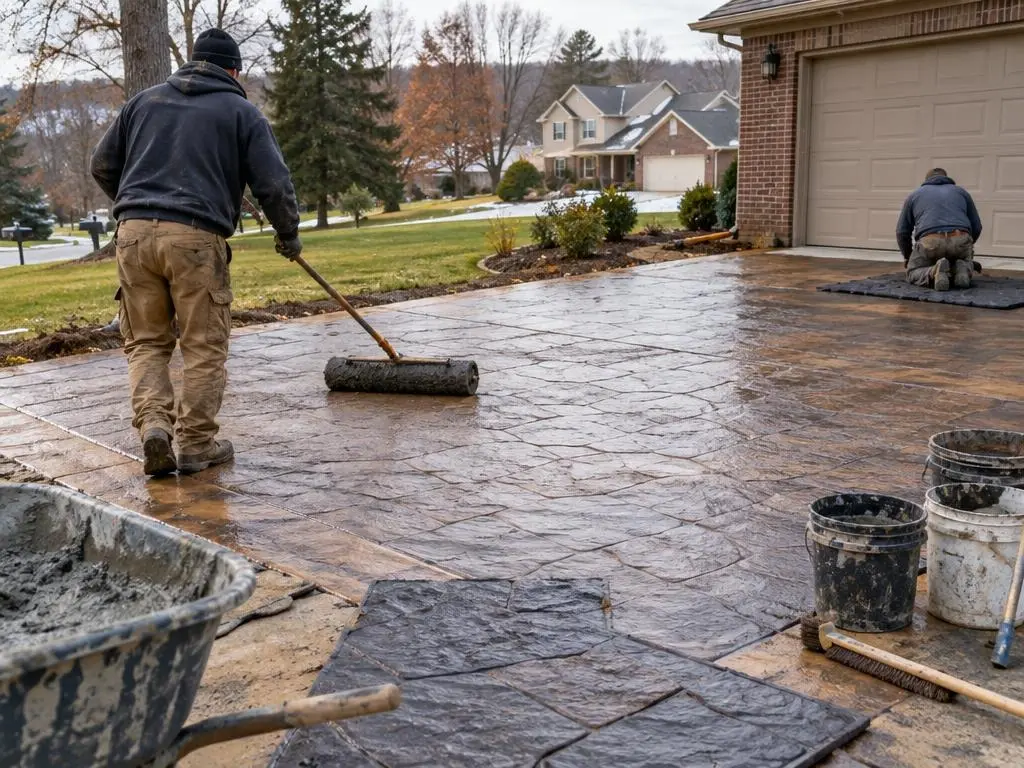
Our Services in Bowling Green, KY
Bowling Green Questions
Do I need a permit to replace my driveway apron in Bowling Green?
If the work touches the city right of way, curb, gutter or public sidewalk, the city requires a right-of-way permit from Public Works' Planning and Design Division, requested at least 24 hours before work. We confirm whether your apron falls in that zone during the estimate.
Can you pour a patio where there used to be a sinkhole?
Only after the ground is stable. Report a new sinkhole to Public Works first. Once it has been repaired or filled properly, we rebuild a compacted stone base and pour. We will not pour over an open or active depression.
Why do so many Bowling Green walks crack near the house?
Downspouts often dump water right at the edge of the walk. On clay soil that gets soft when wet, the base moves and the slab cracks. We fix the drainage along with the concrete so the new section does not repeat the problem.
Free Estimates in Bowling Green, KY
Written estimates anywhere in Bowling Green, from College Hill to the newest subdivisions.
Concrete Contractors Near Bowling Green
- Concrete Contractors in Plum Springs, KY
- Concrete Contractors in Bristow, KY
- Concrete Contractors in Plano, KY
- Concrete Contractors in Rich Pond, KY
- Concrete Contractors in Smiths Grove, KY
- Concrete Contractors in Oakland, KY
- Concrete Contractors in Woodburn, KY
- Concrete Contractors in Alvaton, KY
- Concrete Contractors in Rockfield, KY
- Concrete Contractors in Richardsville, KY
- Concrete Contractors in Hadley, KY
- Concrete Contractors in Franklin, KY
- Concrete Contractors in Scottsville, KY
- Concrete Contractors in Russellville, KY
- Concrete Contractors in Auburn, KY
- Concrete Contractors in Glasgow, KY
- Concrete Contractors in Park City, KY
- Concrete Contractors in Cave City, KY
- Concrete Contractors in Brownsville, KY
- Concrete Contractors in Morgantown, KY