
Pads for sheds, garages and shops
Concrete Slabs in Bowling Green, KY
A flat, level base sized and reinforced for what it has to carry.
- Estimate visits that start with your soil, slope and downspouts
- Every quote broken out: base, thickness, steel, finish and tear-out
- City right-of-way permit sorted out before work near the street
A Slab Built for the Load on Top
Concrete slabs are the flat pads that sheds, detached garages, workshops, carports, hot tubs, generators and HVAC units sit on. Unlike a patio, a slab is built around a load. A garden shed and a two-car garage full of vehicles need very different thickness, edges and reinforcement. On Bowling Green's clay soil, the base and the drainage around the slab decide whether it stays level.
Common slab projects
- Shed pads, usually a little larger than the shed so the walls sit fully on concrete.
- Detached garage and shop slabs, with thickened edges for walls and heavier sections where vehicles or equipment park.
- Carport and RV pads, built thicker for heavy wheels.
- Hot tub pads, sized and reinforced for a filled tub.
- Equipment pads for HVAC units, generators and trash bins.
- Basement and crawlspace floors, poured over a vapor barrier.
Thickness and reinforcement
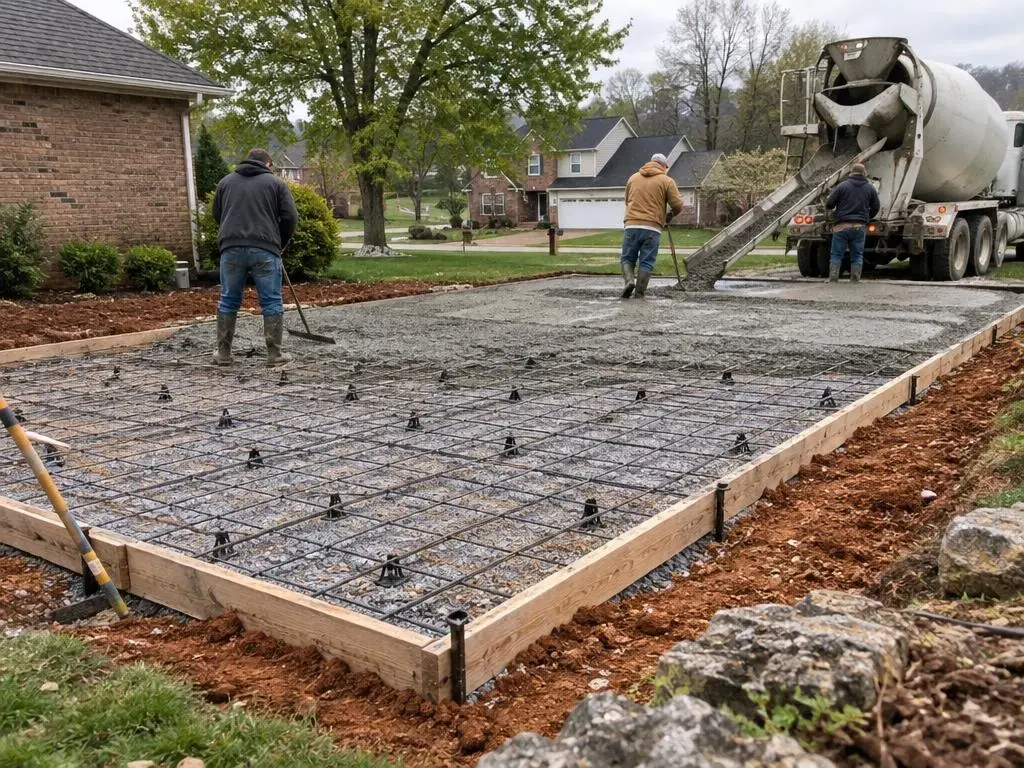
HomeGuide notes that shed slabs are often about 4 inches thick and two-car garage floors 4 to 6 inches with reinforcement. We size the slab to the load. A garage or shop slab usually gets thickened edges under the walls and rebar or wire mesh across the slab. If anchor bolts are needed for a building, we set them in the fresh concrete where the builder needs them.
Base, vapor barrier and drainage
Slabs in Bowling Green sit on clay over limestone. The city geologist told WKU Public Radio that wet clay gets heavier and more plastic and breaks more easily. That is why we dig to firm ground, compact a crushed stone base and grade the area so water flows away from the slab. For any slab under a building that will be enclosed and stored in, a vapor barrier under the concrete helps keep ground moisture from coming up through the floor. If the slab sits in a low spot where water collects after storms, we talk about raising it or adding drainage before we pour.
Level, square and ready to build on
A building slab has to be square and level so walls go up straight. We set forms to string lines and check the diagonals before the pour. For a shed or garage kit, give us the manufacturer's footprint and any foundation details so the slab matches. For a slab that will become a heated shop or living space, ask your builder about insulation and plumbing before we pour, because those go in first.
Signs an old slab needs replacing
- A shed or building that leans or has doors that no longer close
- Cracks with one side higher than the other
- Water coming up through or pooling on the slab
- Crumbling edges where the slab was too thin
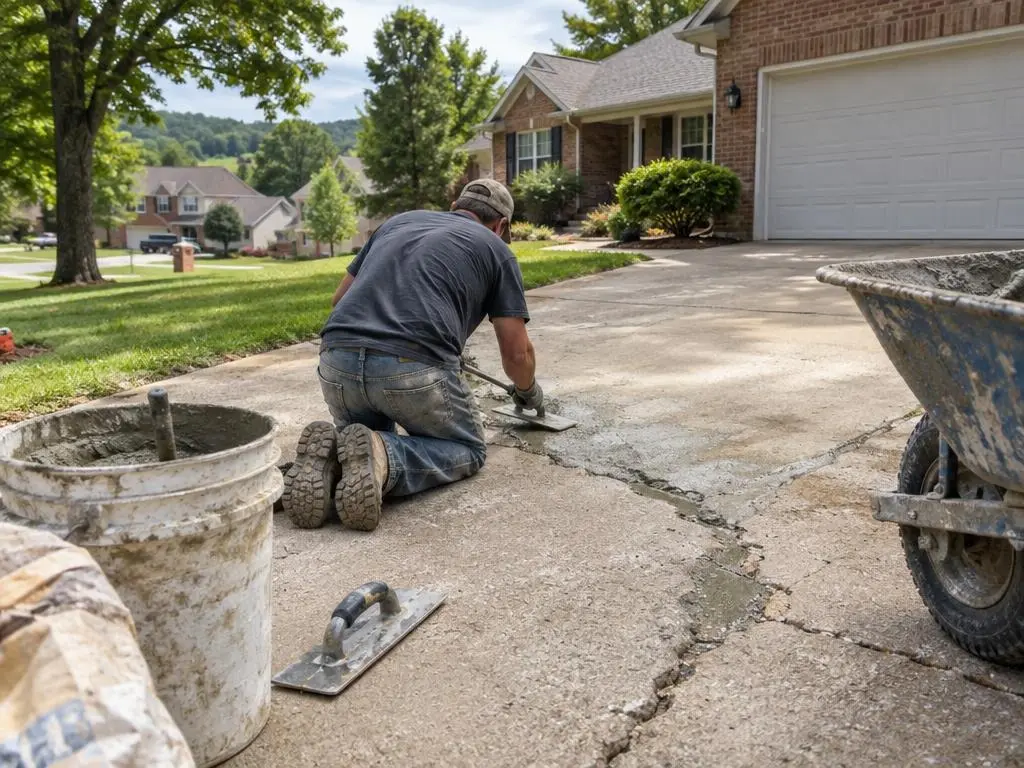
Some of these can be fixed with leveling or repair, covered on our Concrete Repair page. If the slab is broken through or too thin for its load, replacement is the fix.
Curing before the build
Concrete needs time before heavy loads go on it. A shed can often be set within a week, while framing a garage or setting heavy equipment usually waits longer. We give you timing for your mix and the season.
Slab Types We Pour
Each slab is sized for its footprint and the weight it will carry.
Shed and storage pads
Level pads a little larger than the building footprint.
Garage and shop slabs
Thickened edges, reinforcement and anchor bolts for framing.
Carport and RV pads
Thicker slabs for heavy vehicles and trailers.
Hot tub pads
Reinforced pads sized for a filled tub and access around it.
Equipment pads
Small pads for HVAC units, generators and bins.
Vapor barriers
Poly sheeting under slabs for enclosed buildings and storage.
Typical Concrete Slab Costs
| Slab | Published range |
|---|---|
| Per square foot, installed | $6 to $12 |
| 10' x 10' (100 sq ft) | $600 to $1,200 |
| 12' x 12' (144 sq ft) | $860 to $1,700 |
| 20' x 20' (400 sq ft) | $2,400 to $4,800 |
| 30' x 30' (900 sq ft) | $5,400 to $10,800 |
| Two-car garage floor (400 to 576 sq ft) | $2,400 to $6,900 |
| 4-inch slab, per square foot | $6 to $8 |
| 6-inch slab, per square foot | $8 to $10 |
| Gravel base, per square foot | $1 to $3 |
National ranges from HomeGuide's concrete slab cost guide. Thickened edges, rebar, vapor barrier, site prep and access change the price. Your written estimate is the price.
How a Slab Gets Built
1. Size it
We confirm the footprint, the load and any anchor bolt or kit requirements.
2. Excavate and base
Soil dug to firm ground, stone compacted, vapor barrier laid where needed.
3. Form and reinforce
Forms set square and level, thickened edges dug, rebar or mesh placed.
4. Pour and cure
Concrete placed, finished, cut and cured before the build goes on.
Concrete Slabs Questions
How thick should a shed slab be?
HomeGuide notes that shed slabs are usually about 4 inches thick. Larger sheds, workshops with heavy tools, or any slab that will see a vehicle should go thicker with reinforcement.
Do I need rebar in a slab?
Small pads under light loads can do without it, but garage, shop and vehicle slabs should be reinforced. Rebar or mesh holds cracked sections together and level.
How big should a shed pad be?
Most pads are a few inches larger than the shed on every side so the walls sit fully on concrete. Check the shed maker's foundation details and give them to us before the pour.
How much does a 20 by 20 slab cost?
HomeGuide lists about $2,400 to $4,800 for a 20 by 20 slab. Thickened edges, a vapor barrier and site prep can raise that. We price it after seeing the spot.
Concrete Slabs Service Areas
- Concrete Contractors in Bowling Green, KY
- Concrete Contractors in Plum Springs, KY
- Concrete Contractors in Bristow, KY
- Concrete Contractors in Plano, KY
- Concrete Contractors in Rich Pond, KY
- Concrete Contractors in Smiths Grove, KY
- Concrete Contractors in Oakland, KY
- Concrete Contractors in Woodburn, KY
- Concrete Contractors in Alvaton, KY
- Concrete Contractors in Rockfield, KY
- Concrete Contractors in Richardsville, KY
- Concrete Contractors in Hadley, KY
- Concrete Contractors in Franklin, KY
- Concrete Contractors in Scottsville, KY
- Concrete Contractors in Russellville, KY
- Concrete Contractors in Auburn, KY
- Concrete Contractors in Glasgow, KY
- Concrete Contractors in Park City, KY
- Concrete Contractors in Cave City, KY
- Concrete Contractors in Brownsville, KY
- Concrete Contractors in Morgantown, KY
Get a Concrete Slabs Estimate
Free on-site estimates for slabs and pads in Bowling Green and Warren County.